
Plenary Talk
Jazz-Inspired Harmony Search
Algorithm and Its Various Applications
 Zong Woo Geem
Professor, Department of Smart City at Gachon University, South
Korea
Chief Director of Smart City Research Center at Gachon University,
South Korea
Abstract:
Harmony Search (HS) is a music-inspired optimization algorithm.
This presentation introduces optimization modeling and various
algorithms, then explains the HS mechanism, its theoretical
background, and various applications, especially those in the
Tokyo metropolitan area. The application topics include fuel
cells, power grids, digital twins, feature selection, and
algorithm enhancement. We hope to see more HS applications from
this region in the future.
http://harmonysearch.info/
Biography:
Zong Woo Geem is a full professor in the Department of Smart City
at Gachon University, South Korea. He received B.Eng. from
Chung-Ang University, Ph.D. from Korea University, and M.Sc. from
Johns Hopkins University. He also conducted research at Virginia
Tech, University of Maryland, College Park, and Johns Hopkins
University. He invented the music-inspired evolutionary algorithm,
Harmony Search, which has been applied to various scientific and
engineering problems. His research interests include
phenomenon-mimicking algorithms and their applications in the
fields of energy, the environment, and culture. He has served as
an editor for various journals, including Senior Editor for
Engineering Optimization and Guest Editor for Swarm and
Evolutionary Computation, Complexity, and Sustainability.
Plenary Talk
Quantum Computing with Words
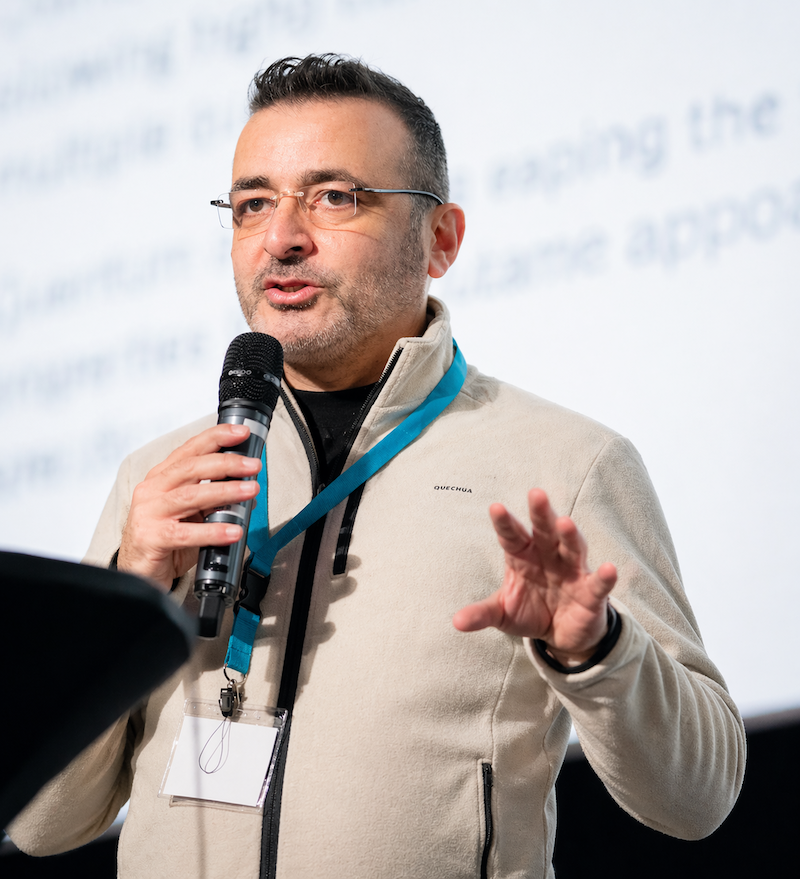 Giovanni Acampora
Full Professor of Computer Science at the Department of Physics
“Ettore Pancini” of University of Naples Federico II, Naples
Chair of IEEE-SA 3781WG
Chair of IEEE-SA 1855WG
Editor in Chief of Springer-Nature Quantum Machine Intelligence
Abstract:
This talk presents a quantum approach to fuzzy inference in which
linguistic rules are encoded as quantum oracles and processed
through superposition and entanglement. Building on recent work on
quantum fuzzy inference engines, it examines how fuzzy rule-based
systems can be reformulated for quantum hardware in order to
mitigate rule explosion and improve the scalability of inference in
high-dimensional, distributed, and data-intensive settings. The
discussion is not limited to a single benchmark, but considers the
broader methodological significance of this framework across
multiple application scenarios, including control and
decision-oriented problems. More broadly, the talk argues that this
research direction is important for a dual reason: it introduces
higher-level, human-readable abstractions for the design of quantum
inference processes, and it highlights the prospect of computational
advantages, including more efficient rule execution on quantum
platforms. In this sense, Quantum Computing with Words may be viewed
as a contemporary extension of Zadeh’s original vision.
Biography:
Giovanni Acampora is a Full Professor of Computer Science at the
Department of Physics “Ettore Pancini” of University of Naples
Federico II, Naples. In this context, he leads the research
activities of the Quantum Computing and Smart Systems Laboratory
(QUASAR Lab) and coordinates the teaching activities of both the PhD
in Computational Intelligence and the Quantum Computing Academy.
From 2013 to 2016, he was Reader in computational intelligence with
the School of Science and Technology, Nottingham Trent University,
Nottingham, U.K. From 2012 to 2013, he was with Hoofddocent Tenure
Track in Process Intelligence with the School of Industrial
Engineering, Information Systems, Eindhoven University of
Technology, Eindhoven, The Netherlands. His research interests
include both the theory and application of computational
intelligence and quantum computing. Prof. Acampora is the Chair of
IEEE-SA 3781WG, the working group for the standardization of
taxonomy and terminology of quantum artificial intelligence.
Moreover, He is the Chair of IEEE-SA 1855WG, the working group for
the standardization of the fuzzy markup language. Prof. Acampora
serves as an Editor in Chief of Springer-Nature Quantum Machine
Intelligence. He acted as General Chair of the 2017 IEEE
International Conference on Fuzzy Systems, the 2025 IEEE
International Conference on Quantum Artificial Intelligence, and the
2022 Workshop on Quantum Techniques in Machine Learning. He was the
recipient of the IEEE-SA Emerging Technology Award (2016), the
Canada-Italy Innovation Award for Emerging Technologies (2019), the
IBM Quantum Experience Academic Research Program Award (2021), the
IEEE Computer Society Emerging Technology Award (2022) and the
Fujitsu Quantum Challenge Award (2024). He was also the recipient of
best paper awards at the 2012 United Kingdom Workshop on
Computational Intelligence, the 2021 IEEE International Conference
on Fuzzy Systems, and the 2024 United Kingdom Workshop on
Computational Intelligence.